
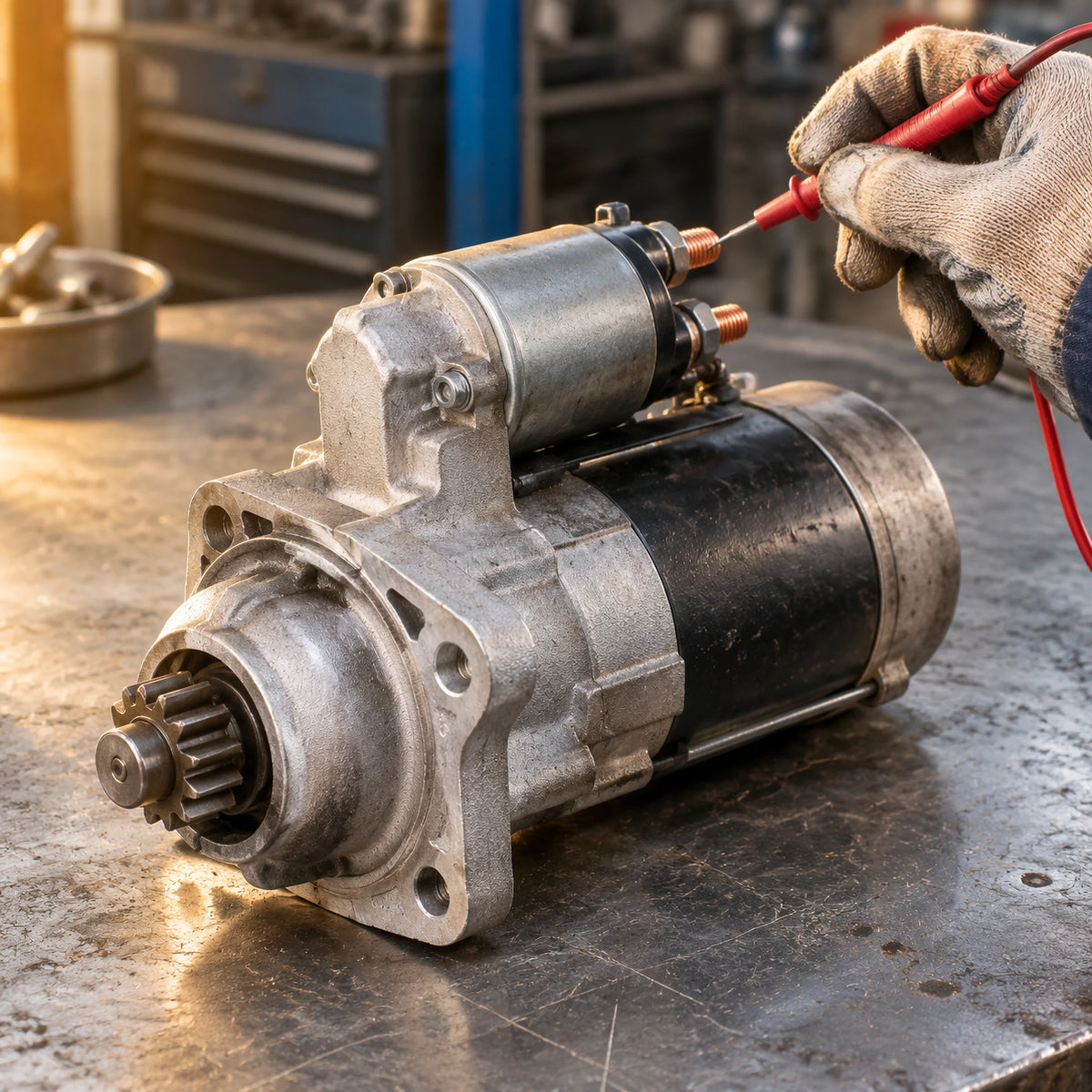
Starter motor failure symptoms arrive as one of three complaints: the engine turns over slower than it used to, it clicks once and nothing happens, or the key produces silence. These are not three versions of one fault — they divide the starting circuit into three sets of suspects, and only one points at the motor. This guide follows Delco Remy's diagnostic sequence and DENSO Aftermarket's voltage-drop specifications. Units are in the starter motor collection.
Three Complaints, Three Circuits
Delco Remy sorts every cranking complaint into three categories — slow crank, click no-crank, no-click no-crank — because each implicates a different part of the circuit. The first two steps are identical regardless of complaint: test the batteries, then the cables. Only then does the path branch, deciding whether you keep chasing wiring or reach for a starter.
What Happens Between Key and Crank
DENSO describes the starter as two sections. The motor produces rotation; the engagement mechanism — pinion gear, magnetic switch, drive lever, overrunning clutch — connects it to the flywheel. The magnetic switch throws the pinion into mesh with the ring gear, then closes the main contacts that feed the motor.
That two-stage action explains the most misunderstood symptom. A single loud click proves the switch received a signal and moved its plunger; it does not prove the contacts pass current, or that enough voltage arrived to complete the stroke. Click and silence belong to different circuits. Related hardware sits in the starter relay and ignition and start system collections.
Pattern 1: Slow Cranking — the Almost-Start
The engine rotates below the speed it needs and may not fire. DENSO puts normal cranking at roughly 200–250 rpm, so this is measurable rather than subjective.
Current draw and cranking voltage settle it. Current should sit at or below the maximum in the repair manual, cranking voltage at or above the specified minimum — typically about 9.6 volts at 20–25 °C. How the two move together is the diagnosis:
- High draw, low cranking speed: the starter — a layer short in the windings, worn brushes or bushings, mechanical blockage — though engine-side drag produces the same picture.
- Low draw, low speed, high cranking voltage: excessive resistance in the starter circuit, not the motor.
Cold weather adds a variable. DENSO notes that excessive oil viscosity, especially when cold, increases the drag the engine presents and reduces the starter's ability to spin it. A machine that cranks slowly only on the first cold start of the day is describing oil, not usually a failing motor.
Once batteries and cables check out and the engine still cranks slowly, Delco Remy's guidance is direct: replace the starter.
Pattern 2: One Click, No Crank
The switch works well enough to make noise, which makes this the pattern most often misdiagnosed as a dead starter — and the one where wiring is most often the real fault.
Delco Remy's instruction is to test the control circuit. Without an integrated magnetic switch on the starter, the control circuit itself needs a voltage drop test. With one, verify the vehicle's control circuit is actually delivering voltage to that switch.
There is a trap worth knowing. Delco Remy notes that almost every manufacturer picks up control-circuit current from the heavy positive post on the solenoid, so a voltage drop in the main battery cable can present as a click rather than a slow crank.
DENSO adds the internal side. If the switch receives proper voltage and the starter still will not rotate, its contacts may be burnt. If the switch makes no noise at all, suspect a defective pull-in coil or plunger.
Pattern 3: No Click, No Crank — Completely Silent
Nothing happens and nothing is heard. Delco Remy's conclusion is blunt: power is not being sent to the solenoid, which makes it very unlikely that the motor is the problem.
Treat this as a control-circuit fault first. Verify battery state of charge, then work through the ignition or start switch, the park/neutral or clutch start switch, the relay and the wiring between them. DENSO's relay procedure is a continuity test in both de-energised and energised states; readings outside specification mean a new relay.
The 0.5 Volt Rule
Voltage drop separates a tired component from a resistive connection, and a cheap meter with long leads can mislead you. Take every reading while cranking, not at rest.
| Test point (cranking) | Acceptable drop | Source |
|---|---|---|
| Total cranking circuit | Less than 0.5 V | Delco Remy |
| Positive terminal to cable clamp | 0 V | DENSO |
| Positive cable, clamp to starter end | 0.2 V or less | DENSO |
| Across the magnetic switch | 0.3 V or less | DENSO |
| Starter housing to negative terminal | 0.2 V or less | DENSO |
| Negative cable, battery to block | 0.2 V or less | DENSO |
| Housing to engine block | 0.2 V or less | DENSO |
A drop that looks trivial on a multimeter is a real loss at cranking current, which is why the limit is written in tenths of a volt. DENSO's faster variant: keep the positive lead on the battery and walk the negative lead back through the circuit while cranking until the reading changes sharply — the fault sits just behind that point.
When the Motor Spins and the Engine Doesn't
A starter that whirs without turning the engine is a mechanical fault. DENSO's advice is to inspect every tooth on the flywheel or flexplate ring gear through the inspection plate on the bell housing or the starter mounting port, looking for wear, damage or missing teeth. A defective drive assembly can imitate a damaged flywheel, so if the pinion meshes correctly but does not rotate the engine, the starter needs inspection for mechanical wear. Delco Remy adds that once a starter is confirmed as the cause, the ring gear should be checked for damage that would damage the replacement too.
Diesel and Off-Highway Differences
Compression is higher, so the torque needed to spin the engine is higher and cranking current sits nearer the top of the specified range. Many machines run 24-volt starting rather than 12-volt, and the two are not interchangeable. Engine size also varies: the same symptom on a 1.5-litre Kubota and a 13-litre Cummins means different parts.
DENSO's warning is worth repeating: never fit a starter with lower output than the application requires — a 1.4 kW unit in place of a 2.0 kW specification draws excessive current and fails early. Fit matters too: fixing holes, terminal positions, pinion tooth count and rotation direction must all match, even when the new unit looks nothing like the old one.
What Long Cranking Destroys
Cranking a sick engine is not a neutral act. DENSO lists the pathway: low battery voltage produces excessive current to the motor, the commutator overheats and its bars lift from the insulator, and the brushes and brush holder take damage. Holding the key in start after the engine fires brings different failures — the control circuit stays closed and burns the magnetic switch main contacts, while the pinion is driven at flywheel speed and commutator bars separate.
Ten seconds of cranking to start means the circuit is already being consumed to cover another fault.
Starter Failure Symptoms: Replace, Repair or Keep Testing
| What you see | Most likely | Confirm with | Then |
|---|---|---|---|
| Slow crank, normal draw, battery and cables good | Worn starter | Load test passed, drops in spec | Replace starter |
| Slow crank, low draw, high cranking voltage | Circuit resistance | Voltage drop tests | Repair cable or ground |
| Single click, no rotation | Control circuit or contacts | Control circuit drop, IMS voltage | Repair wiring, or replace starter |
| Silence, no click | No power to solenoid | Relay continuity, start switch | Repair circuit |
| Spins, engine still | Ring gear or drive assembly | Inspect ring gear teeth | Replace damaged parts |
Matching a Replacement Starter
| Machine / engine | Reference | Type | Price |
|---|---|---|---|
| Cummins | 3957597 | Starter motor | See product page |
| Cummins QSZ13 | 4366046 | Starter motor | See product page |
| Caterpillar C7.1 | 354-5671 / 428000-9122 | 24 V, 10 teeth, 7.8 kW | See product page |
| Kubota D1105 / D905 / V1505 | 16611-63010 | 12 V | See product page |
| Perkins | T837010004 | 24 V, 5 kW | See product page |
| JCB 3CX / 4CX backhoe | 714-11200 / 714-03000 | Starter motor | See product page |
| Yanmar 4TNV84 / 4TNV88 / 4TNE94 | 129900-77010 | Starter motor | See product page |
Part numbers and coverage come from the live product listings. More units are indexed under Cummins; if the complaint is charging rather than cranking, move to the alternator collection — a battery that goes flat between shifts is a charging fault.
FAQ
Can a weak battery look exactly like a bad starter? Yes, which is why battery testing comes first. Load test the bank and replace any battery that fails. A slow crank with normal current draw and correct voltage drops is what justifies replacing the starter.
How do I tell circuit resistance from a failing motor? Read current and voltage together while cranking. Low current with low speed and high cranking voltage indicates resistance; high current with low speed indicates the starter or engine drag. The voltage drop table then localises it.
Why did a new starter fail in a few months? Usually an unrepaired ring gear that damaged the new drive, or an undersized unit drawing excessive current. Match the kW rating, not just the mounting pattern.
Test the Circuit Before You Buy the Motor
Starter motor failure symptoms are cheap to diagnose and expensive to guess at. Load test the batteries, take four voltage drop readings while cranking, then read current and voltage together — that separates a worn motor from a resistive cable, a dead relay or a damaged ring gear before any money moves. The starter motor collection carries 12 V and 24 V units for Cummins, Caterpillar, Kubota, Perkins, John Deere, Yanmar, Deutz, Isuzu and JCB applications; for background, read what the starter does and our guide to testing a solenoid. If the crank is fine and the engine simply will not run, start from the diesel fault overview.


