
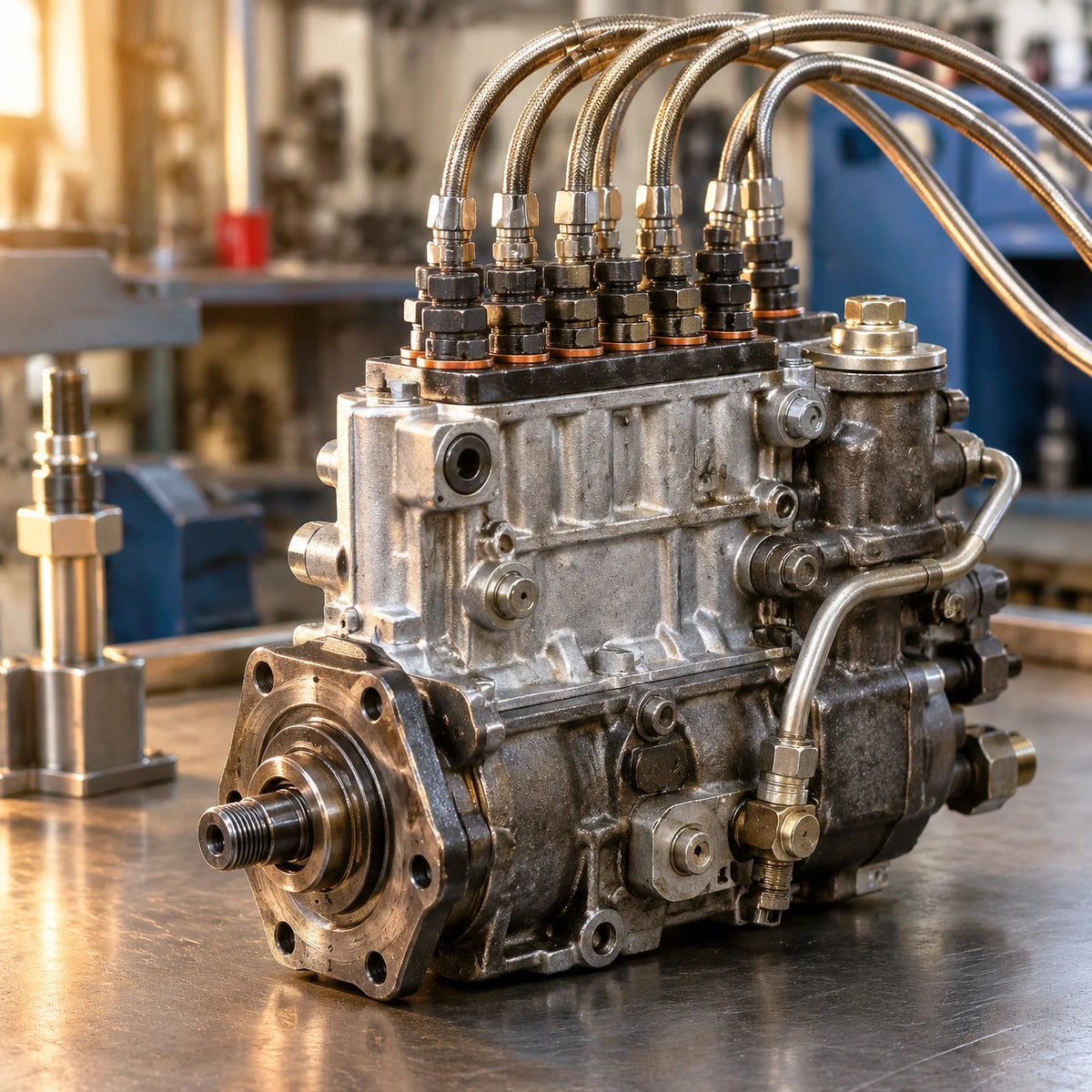
Injection pump failure symptoms are easy to misread, because the pump shares them with the injectors, the lift pump, the filter and a plain air leak. The tell is a pattern, not a single sign: a pump losing internal pressure starts badly when hot, pulls weakly only under load, and leaves the injectors looking innocent on a bench test. This guide separates the pump from everything upstream and downstream of it.
What the Term "Injection Pump" Actually Covers
The symptoms differ by pump family, so identify what you have before reading any of them.
Inline pumps
One pumping element per cylinder, each with its own plunger and delivery valve. Think Bosch P7100 or the classic A-type. When one element wears, that cylinder goes weak while the rest keep working — an uneven, cylinder-specific fault.
Rotary distributor pumps
A single rotating plunger pressurises fuel and distributes it to each outlet in turn — Bosch VE, VP30, and the Delphi DPA and DP210 families. Because every cylinder draws from the same plunger and the same hydraulic head, wear shows up as a global loss of delivery and pressure rather than one dead cylinder. Browse the injection pump range to see how many of these are still in daily service on Kubota, Perkins, Caterpillar and Deutz engines.
Common rail high-pressure pumps
One pump feeds a shared rail and the injectors meter. The pump can fail mechanically or the rail pressure control can fail electronically, and the two look nearly identical from the driver's seat.
Injection Pump Failure Symptoms Worth Acting On
Cranking gets longer, worst when hot
A hot engine that cranks far longer than it does cold is the opposite of normal, and it is the classic signature of a worn internal transfer pump: pressure falls away once the fuel thins and clearances open up.
Power falls off under load, but idle is fine
The engine starts, idles and drives gently, then flattens when you ask for fuel. Worn plungers and barrels let fuel bypass the element at exactly the moment you need maximum delivery, so light-throttle behaviour stays acceptable while load response collapses.
White or blue-white smoke at startup
Unburnt fuel leaving the tailpipe means it arrived late, arrived as droplets, or arrived in the wrong quantity. Late timing from a sticking advance piston and poor atomisation from falling injection pressure both produce it. Note whether the smoke clears as the engine warms — smoke that persists points away from the pump and towards compression or injectors.
Rough idle, hunting, or a miss that moves
A pump-driven miss tends to follow the pump's firing order rather than staying on one cylinder. Idle that gently rises and falls with no throttle input is more likely governor spring fatigue than an injector fault.
Fuel weeping from the pump body
Any external leak — shaft seal, head O-ring, delivery valve holder, AFC housing — is a pump fault that no injector work will fix. On turbocharged rotary pumps, fuel coming out of the AFC vent tube is the giveaway for a ruptured diaphragm or a leaking fuel pin O-ring.
Engine dies and will not restart
A sudden, complete stop with no warning is the signature of an electronic pump's metering circuit or pump control unit letting go, not of gradual mechanical wear. Before condemning the pump, inspect the harness and connector at the pump: chafed wires and corroded pins imitate a dead pump convincingly.
Diesel smell in the oil, or a rising oil level
A failed shaft seal can pass fuel into the timing case or the sump. Confirm with the dipstick: oil that smells of diesel and reads high means stop the engine and fix the seal.
Metal in the fuel filter
Cut the element open and spread the pleats. Fine metallic glitter means something upstream of the filter is shedding material, and the pump's own internals are a prime suspect.
Symptom to Worn Component
| What you observe | Most likely internal cause | What it means for the repair |
|---|---|---|
| Hard hot start, low power, erratic delivery | Internal transfer pump (vane) wear | Pump off, rebuild or replace — no external fix |
| Rough running, miss, uneven delivery | Cam plate lobes or roller wear | Internal, bench calibration required |
| Hard start plus white/blue-white smoke | Plunger and barrel bypass | Internal wear at micron clearances |
| Rough idle, carboned injector tips | Delivery valve deterioration (dribble) | Pump and injectors usually both need attention |
| External leak, intermittent stall, no-restart when hot | Seal and O-ring failure, air ingress | Seal kit first, then reassess |
| Cold start worse than warm start | Cold start advance (KSB) fault | Device-specific, check before condemning the pump |
| Idle hunt, surge, lost governed speed | Governor spring fatigue | Governor rebuild |
| Sudden stop, no restart (electronic pump) | Metering solenoid, timing solenoid or pump ECU | Diagnose electrically before replacing |
Pump or Injectors? Three Tests That Separate Them
Read the return flow
A return-flow or leak-off test measures how much fuel escapes past each injector instead of being injected. Injectors that return far more than their stable siblings are worn internally. If return flow is even across all cylinders but delivery is still low, the fault is upstream — in the pump.
Cut the filter open
Pleat inspection tells you whether the system is generating debris. Clean filter plus low delivery points to wear. Heavy glitter points to a component already failing and warns you that the replacement pump will be contaminated by whatever is still in the lines and tank.
Crack a line and look for air
Fit a length of clear hose on the return while the engine runs. Bubbles mean air is entering on the suction side — a cracked filter head, a perished hose, or a leaking pump seal. Air produces hard starts, stalling and a "runs fine for an hour then will not restart" pattern that mimics pump failure perfectly.
Check the Low-Pressure Side Before the Pump Comes Off
A large share of pumps replaced for low delivery were starved by something cheap: a restricted filter, a tired lift pump, a collapsed hose or a tank pickup drawing air. Measure supply pressure and flow at the pump inlet against the engine manufacturer's specification. If supply pressure sags under load, fix that first — a new pump will fail the same way. Our fuel system troubleshooting guide walks through that sequence, and the fuel pump range covers the supply side.
What Wears These Pumps Out
Water and abrasive debris remove the film that separates plungers from barrels; without it, micron clearances open quickly and delivery drops. Long storage lets varnish and corrosion form inside the hydraulic head and on delivery valves, and air ingress allows cavitation on the low-pressure side. Governor springs and diaphragms also age whether the engine runs or not, which is why low-hour standby generators still arrive with pump faults.
Fault Codes: Useful, Not Conclusive
Electronically controlled pumps set codes such as P0251, "Injection Pump Fuel Metering Control 'A' Malfunction," covering cam, rotor and injector circuits. Read it as a pointer into the fuel system, not a verdict — the same code appears for a failed solenoid, a wiring fault and genuine internal wear, and many industrial and agricultural engines report nothing at all. Always confirm with a mechanical test before ordering parts.
Rebuild or Replace: Which Route Makes Sense?
| Situation | Sensible route |
|---|---|
| External leaks, hard starting, no debris | Seal kit and recalibration by a pump shop |
| Worn internals, housing sound, no contamination | Rebuild with genuine parts and bench calibration |
| Cracked housing, broken shaft, heavy internal damage | Replace the unit |
| Metal through the whole system | Replace pump and injectors, flush lines and tank |
| Electronics failed, mechanicals healthy | Replace the electronic module or the complete pump |
A rebuilt pump must be calibrated on a test bench, not just reassembled: delivery balance between outlets is what decides whether the engine runs smoothly, and it cannot be judged by ear.
Buying a Replacement Pump Without Getting Burned
Match the OEM number first and the application second. A pump sold as fitting "Cummins 6BT" may be correct for one rating and wrong for another, and timing advance curves differ between them. Cross-check every interchange number on the listing — for example the Deutz 0428-1810 unit pump at $332.80, the Kubota 1G852-51012 for V2203 and V2403 at $439, the Perkins 131017961 for 400 series from $639, the Caterpillar 308-1905 for 226B and 3024C at $790, the Cummins 4307021 for QSL8.9 and ISC8.3 at $739, or the remanufactured Delphi DP210 for Perkins at $1,299. Remanufactured units are a legitimate route when the housing is reusable, provided the core is exchangeable and the calibration certificate is real. Also budget for the parts that make the job last: new fuel filters, a verified lift pump, and clean fuel in the tank.
FAQ
Can a failing injection pump damage the injectors? Yes. A worn delivery valve lets pressure dribble away after each injection, which carbonises nozzle tips, and internal debris is carried straight to the injectors. That is why pump and injector condition should be judged together, as covered in our guide to cleaning injectors in place and to injector failure repair.
Will a pump fail without any warning? Mechanical pumps usually give weeks of hard hot starting and weak load response first. Electronic pumps are the exception — a metering solenoid or control unit can fail between one start and the next.
Is it worth rebuilding a high-hour pump? If the housing and shaft are sound and the system is clean, yes: a calibrated rebuild restores delivery balance at a fraction of a new unit's price.
If the pattern points at the pump, start with the numbers on your pump tag. Shop the injection pump collection by brand — Cummins, Kubota, Caterpillar, Deutz — or send us the OEM number and engine serial and we will match it against our fuel system parts and injector nozzle range.


